
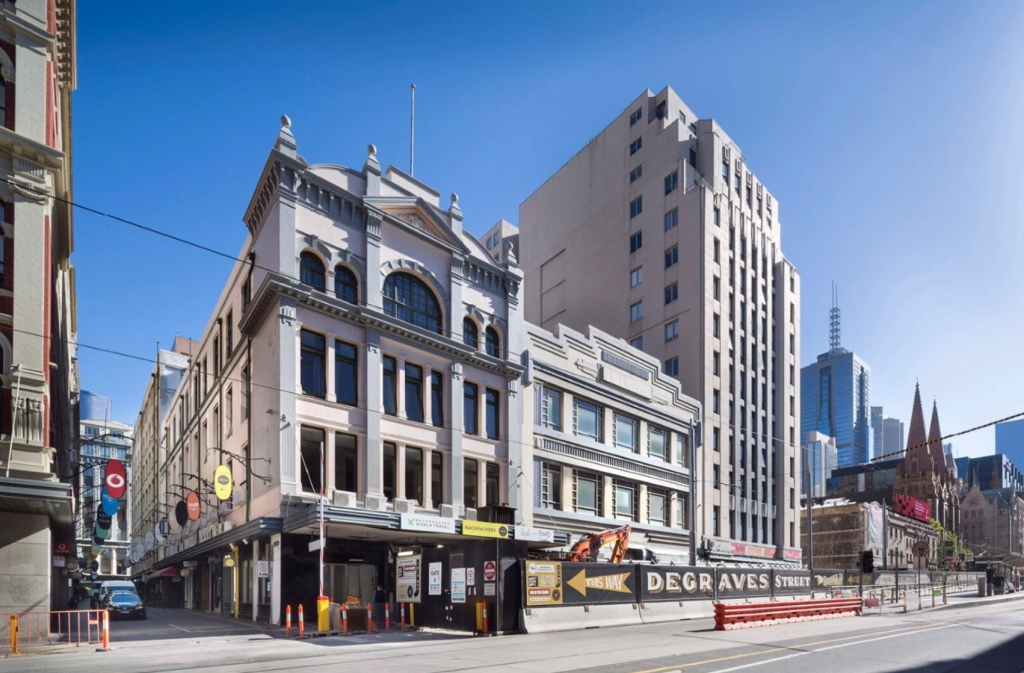
Following the Victorian Government’s decision to scrap plans for a second medically supervised injecting facility in the Melbourne CBD due to pressure from the business sector, a building at 244 Flinders Street was repurposed into a comprehensive medical and health facility for disadvanted people to reduce drug harms. The facility officially opens its doors on Monday, 19 October 2026, with a specialised hydromorphone trial scheduled to commence in 2027 a feature of the new service.
This is not the first time a trial of injectable hydromorphone has been conducted in Australia.
A recent successful Sydney 2 year trial was unfortunately time-limited by protocol. Participants had to stop the injectable component within the two-year maximum period. No ongoing NSW government funding has since been provided. It was a restictive feasibility grant, not a funded ongoing service. It was funded by an NHMRC partnership grant plus Uniting NSW ACT and St Vincent’s Hospital Sydney. Many concerns have been raised about why this treatment hasn’t continued. Many would say that the government response was ‘tokenistic’.
Australia has a long history of political blockage here. Prof Alison Ritter has noted: “while an Australian heroin trial was proposed in the Australian Capital Territory in 1996, it didn’t proceed for purely political reasons”. The ACT heroin trial was blocked by the then Prime Minister John Howard whose anti-harm minimisation views were at the forefront of the trial not going ahead.
In the case of the NSW hydromorphone trial, it took a combination of a Church, a University and a Hospital to finally get the trial off the ground against weak government support.
Despite research cited by the Victorian government that states participants experience high rates of retention, sustained reductions in illicit heroin and marked health and social improvements, including reductions in criminal activity, there is a proposal to have only 30 people participate in the trial. Half the number in NSW.
There is a significant level of scepiticism about the Victorian State governments commitment to this trial given their axing of the proposed second injecting room. Questions have been asked about why this is a ‘trial’ when there have been other successful trials – and why the low numbers? Are there ongoing government concerns that have been raised by the business community about the amenity of the area with trial participants accessing the site from the busy Flinders Street? Many have highlighted that hydromorphone is a treatment, not a trial, and It needs to be urgently rolled out on a much bigger scale.
Will this again be a short term ‘tick the box’ activity – just to keep the treatment sector happy?
Author: Greg Denham HRA